Tampilkan postingan dengan label Underwater. Tampilkan semua postingan

Selasa, 17 Juli 2018

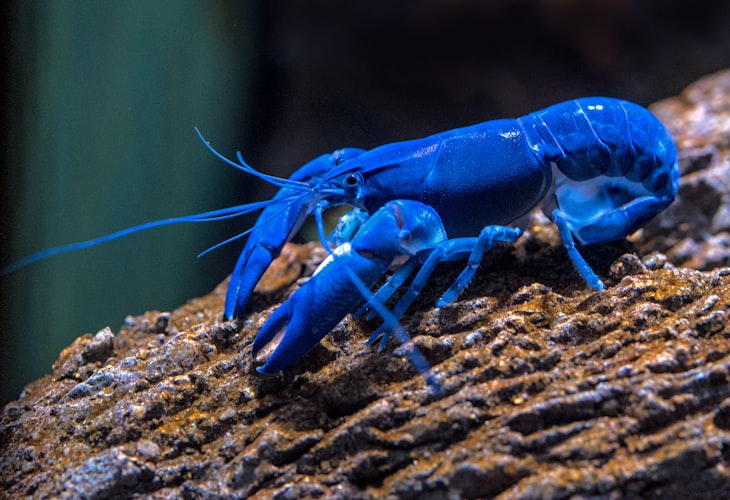
Blue Lobster Side View

Blue Lobster Side View


Homarus gammarus is a large crustacean, with a body length up to 60 centimetres (24 in) and weighing up to 5–6 kilograms (11–13 lb), although the lobsters caught in lobster pots are usually 23–38 cm (9–15 in) long and weigh 0.7–2.2 kg (1.5–4.9 lb).Like other crustaceans, lobsters have a hard exoskeleton which they must shed in order to grow, in a process called ecdysis (moulting).This may occur several times a year for young lobsters, but decreases to once every 1–2 years for larger animals.
The first pair of pereiopods is armed with a large, asymmetrical pair of claws.The larger one is the "crusher", and has rounded nodules used for crushing prey; the other is the "cutter", which has sharp inner edges, and is used for holding or tearing the prey.Usually, the left claw is the crusher, and the right is the cutter.
The exoskeleton is generally blue above, with spots that coalesce, and yellow below.The red colour associated with lobsters only appears after cooking.This occurs because, in life, the red pigment astaxanthin is bound to a protein complex, but the complex is broken up by the heat of cooking, releasing the red pigment.
The closest relative of H. gammarus is the American lobster, Homarus americanus. The two species are very similar, and can be crossed artificially, although hybrids are unlikely to occur in the wild since their ranges do not overlap.The two species can be distinguished by a number of characteristics:

The rostrum of H. americanus bears one or more spines on the underside, which are lacking in H. gammarus.
The spines on the claws of H. americanus are red or red-tipped, while those of H. gammarus are white or white-tipped.
The underside of the claw of H. americanus is orange or red, while that of H. gammarus is creamy white or very pale red.

One of these blue lobsters finally posed for me at the Cairns aquarium.

Copyright
David Clode
Location
Cairns Aquarium, Cairns City, Australia
Download Full-Res Image

Clown Triggerfish

Clown Triggerfish

The clown triggerfish is a small sized fish which grows up to 50 cm.Its body has a stocky appearance, oval shape and compressed laterally. The head is large and represents approximately one third of the body length. The mouth is small, terminal and has strong teeth.
The first dorsal fin is composed of three spines, one of which is longer and stronger. It is erectile and hidden in a dorsal furrow. This set of dorsal spines composed a trigger system which is a characteristic from the family Balistidae. The second dorsal fin is similar in shape and size to the anal fin which is symmetrically opposed to it. The pelvic fin is reduced to a ventral protrusion.
The background coloration is black. Half of inferior part of the body is marked with big white spots which are more or less round. The area around the first dorsal fin is crossed by yellowish sinuosities which draw like a network reminding the leopard's patterns. There is a yellowish ring around the mouth, which is surrounded by another fin white ring. A white stripe ride the snout just under the eyes level. The second dorsal fin and the anal fin are white and underlined with a yellow line at their base. The caudal peduncle has a yellowish blotch on its top part and has three horizontal sets of spiny scales. The caudal fin is yellowish in its center and has black margin. Juveniles have a black background coloration spangled with small white spots, the extremity of the snout and the base of the first dorsal fin is yellowish.

The Clown triggerfish has a bizarre pattern. Triggerfish are territorial, and will sometimes bite a scuba diver who has intruded into their territory.

Copyright
David Clode
Location
Cairns Aquarium, Cairns City, Australia
Download Full-Res Image

Comical Cownose Ray

Comical Cownose Ray


The cownose ray (Rhinoptera bonasus) is a species of eagle ray found throughout a large part of the western Atlantic and Caribbean, from New England, United States to southern Brazil (East Atlantic populations are now generally considered a separate species, R. marginata). Cownose rays grow rapidly, and male rays often reach about 35 inches (89 cm) in width and weigh 26 pounds (12 kg). Females typically reach 28 inches (71 cm) in width and weigh 36 pounds (16 kg).
Cownose rays appear naturally in the Eastern Atlantic Ocean, the Western Atlantic Ocean. Within the Eastern Atlantic Ocean, the cownose ray can often be found in Mauritania, Senegal, and Guinea. In the Western Atlantic Ocean they are located from Southern New England to Northern Florida in the United States, as well as throughout the Gulf of Mexico, Trinidad, Venezuela, and Brazil.

They live in Brackish and marine habitats and can be found at depth up to 22 meters. They are gregarious and migrate extremely long distances, often traveling in schools.

These unusual rays have a comical look to them. This one seemed to pose for me, and seemed to want to be photographed.

Copyright
David Clode
Location
Cairns Aquarium, Cairns City, Australia
Download Full-Res Image

Copperband Butterfly Fish

Copperband butterflyfish


These fish are easily identified by the yellow banding and long snout. The young fish are similar in appearance to adult fish. Butterflyfish grow up to 20 cm in length.The fish appears taller than its length because of its compressed, deep-bodied form with a long dorsal and posterior fins as well as its vertical yellow stripes on a white background. The snout is long and slender, and the dark eye of the fish is less conspicuous than the dark eye-spot on the dorsal fin. The base of the tail features a dark band that runs perpendicular to the tail. Butterflyfish may be distinguished from the similar C. marginalis by their color pattern and number of dorsal fin rays.
Copperband butterflyfish are found at depths of 1−25 metres either alone or in pairs. These fish form monogamous pairs during breeding. They are usually found on coral reefs or rocky shorelines, and also in estuaries and silty inner reefs. This species is territorial and oviparous.

A beautiful butterfly fish that lives on coral reefs. Also called a Beaked Coralfish.

Copyright
David Clode
Location
Cairns Aquarium, Cairns City, Australia
Download Full-Res Image

Pink Starfish

Pink Starfish
The pink star can reach a diameter of two feet while weighing up to two pounds, and has spines less than 2 mm long. It has a soft, flabby texture that allows it to bend slightly to stay on coral.

Pisaster brevispinus is usually found on sand or mud where it catches its prey such as clams or sand dollars. Smaller individuals are sometimes seen on rocks or pilings where they prey on mussels, barnacles, and tube worms. This species is also known to scavenge on dead fish and squid. The giant pink sea star does not tolerate being out of water very well, so it is generally found on the beach only during very low tides. It usually lives at a depth of 180 metres (590 ft).

This is the underside of a pretty pink starfish up against the glass in a tank at the Cairns aquarium.

Copyright
David Clode
Location
Cairns Aquarium, Cairns City, Australia
Download Full-Res Image

Yellow Mellow

Yellow Mellow
life of fish and creatures in the water, beautiful. keep us from damage, so our children and grandchildren can look to this beautiful


Copyright
Craig Lovelidge
Location
Zoomarine, Albufeira, Portugal
Download Full-Res Image