Tampilkan postingan dengan label Saturn. Tampilkan semua postingan

Selasa, 03 Juli 2018

Spring at the North Pole

Spring at the North Pole

The north pole of Saturn, in the fresh light of spring, is revealed in this color image from NASA's Cassini spacecraft. The north pole was previously hidden from the gaze of Cassini's imaging cameras because it was winter in the northern hemisphere when the spacecraft arrived at the Saturn system in 2004.
A hurricane-like storm circling Saturn's north pole at about 89 degrees north latitude is inside the famous "hexagon" feature, which scientists think is a wandering jet stream that whips around the north pole at about 220 miles per hour (98 meters per second). It folds into a six-sided shape because the hexagon is a stationary wave that guides the path of the gas in the jet. The hexagon borders occur at about 77 degrees north latitude and the feature is wider than two Earths. Saturn's rings can be seen at the upper right of the image.
Images with red, green and blue spectral filters were combined to create this natural-color view, which is what the human eye would see if we were there at Saturn. The image here was acquired with the Cassini spacecraft wide-angle camera on Nov. 27, 2012 at a distance of approximately 260,000 miles (418,000 kilometers) from Saturn and at a sun-Saturn-spacecraft, or phase, angle of 96 degrees. Image scale is 18 miles (28.6 kilometers) per pixel.
A false-color version of this image can be seen at Enter the Vortex ... in Psychedelic Color.
The Cassini-Huygens mission is a cooperative project of NASA, the European Space Agency and the Italian Space Agency. The Jet Propulsion Laboratory, a division of the California Institute of Technology in Pasadena, manages the mission for NASA's Science Mission Directorate in Washington. The Cassini orbiter and its two onboard cameras were designed, developed and assembled at JPL. The imaging team is based at the Space Science Institute, Boulder, Colo.

view full-res JPG

In Saturn's Shadow

Saturn
With giant Saturn hanging in the blackness and sheltering Cassini from the sun's blinding glare, the spacecraft viewed the rings as never before, revealing previously unknown faint rings and even glimpsing its home world.
This marvelous panoramic view was created by combining a total of 165 images taken by the Cassini wide-angle camera over nearly three hours on Sept. 15, 2006. The full mosaic consists of three rows of nine wide-angle camera footprints; only a portion of the full mosaic is shown here. Color in the view was created by digitally compositing ultraviolet, infrared and clear filter images and was then adjusted to resemble natural color.
The mosaic images were acquired as the spacecraft drifted in the darkness of Saturn's shadow for about 12 hours, allowing a multitude of unique observations of the microscopic particles that compose Saturn's faint rings.
Ring structures containing these tiny particles brighten substantially at high phase angles: i.e., viewing angles where the sun is almost directly behind the objects being imaged.
During this period of observation Cassini detected two new faint rings: one coincident with the shared orbit of the moons Janus and Epimetheus, and another coincident with Pallene's orbit. (See The Janus/Epimetheus Ring and Moon-Made Rings for more on the two new rings.)
The narrowly confined G ring is easily seen here, outside the bright main rings. Encircling the entire system is the much more extended E ring. The icy plumes of Enceladus, whose eruptions supply the E ring particles, betray the moon's position in the E ring's left-side edge.
Interior to the G ring and above the brighter main rings is the pale dot of Earth. Cassini views its point of origin from over a billion kilometers (and close to a billion miles) away in the icy depths of the outer solar system. See Pale Blue Orb for a similar view of Earth taken during this observation.
Small grains are pushed about by sunlight and electromagnetic forces. Hence their distribution tells much about the local space environment.
A second version of the mosaic view is presented here in which the color contrast is greatly exaggerated. In such views, imaging scientists have noticed color variations across the diffuse rings that imply active processes sort the particles in the ring according to their sizes.
Looking at the E ring in this color-exaggerated view, the distribution of color across and along the ring appears to be different between the right side and the left. Scientists are not sure yet how to explain these differences, though the difference in phase angle between right and left may be part of the explanation. The phase angle is about 179 degrees on Saturn.
The main rings are overexposed in a few places.
This view looks toward the unlit side of the rings from about 15 degrees above the ringplane.
Cassini was approximately 2.2 million kilometers (1.3 million miles) from Saturn when the images in this mosaic were taken. Image scale on Saturn is about 260 kilometers (162 miles) per pixel.

view full-res JPG


Saturn in the Infrared by Kevin M. Gill

Saturn

A false-color view of Saturn's clouds. From the producer, Kevin M. Gill: This image is "made from uncalibrated (raw) infrared filtered images from Cassini, taken on July 20, 2016. I mapped the CB2 filtered image (.75 micron wavelength) to red, MT2 (.727 microns) to green, and MT1 (.619 microns) to blue."
The Cassini-Huygens mission is a cooperative project of NASA, the European Space Agency and the Italian Space Agency. The Jet Propulsion Laboratory, a division of the California Institute of Technology in Pasadena, manages the mission for NASA's Science Mission Directorate, Washington, D.C. The Cassini orbiter and its two onboard cameras were designed, developed and assembled at JPL. The imaging operations center is based at the Space Science Institute in Boulder, Colo.

view full-res JPG

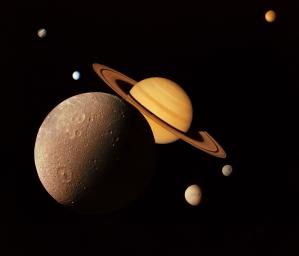
Saturn System Montage

Saturn 
This montage of images of the Saturnian system was prepared from an assemblage of images taken by the Voyager 1 spacecraft during its Saturn encounter in November 1980. This artist's view shows Dione in the forefront, Saturn rising behind, Tethys and Mimas fading in the distance to the right, Enceladus and Rhea off Saturn's rings to the left, and Titan in its distant orbit at the top. The Voyager Project is managed for NASA by the Jet Propulsion Laboratory, Pasadena, California.

view picture full-res JPG
download full-res TIFF